Is Wing Chun Good for Self-Defence? An Honest Answer
This is the most common question we hear from people considering martial arts training. It deserves a direct and honest answer — not a sales pitch, and not false modesty.
Wing Chun, properly taught and properly trained, is one of the most effective close-range self-defence systems in existence. Here’s why — and what the honest caveats are.
Why Wing Chun Works for Self-Defence
Wing Chun was designed from the beginning for real confrontation — not sport, not demonstration, not ceremony. The system’s principles reflect this origin directly.
First: Wing Chun operates at close range, which is where most real-world confrontations happen. Unlike arts built around long kicks and circular strikes, Wing Chun is optimised for the distance at which things actually go wrong — within arm’s reach, in a corridor, against a wall, in a crowd.
Second: Wing Chun attacks the most vulnerable points of the human body along the shortest possible path. The straight punch targets the centreline — the nose, throat, solar plexus — and travels faster than a hook or a haymaker precisely because it doesn’t deviate from the direct line.
Third: Wing Chun does not require physical superiority. The principle of redirecting force rather than opposing it means that a trained Wing Chun practitioner can neutralise someone considerably larger and stronger. This is not theoretical. It is the physical consequence of leverage, angle and timing applied correctly.
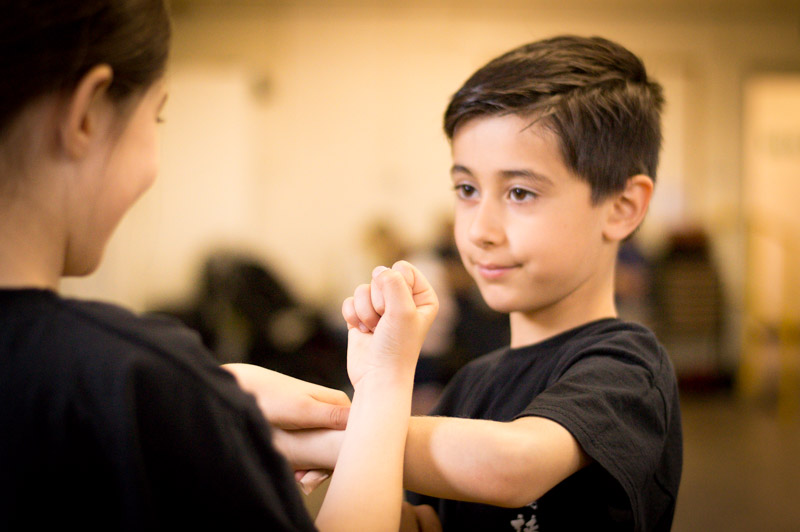
Fourth: Chi Sao — sticking hands training — develops the ability to respond to an attack without having to visually process it first. In a real confrontation, where events happen in fractions of a second, this reflexive sensitivity is genuinely valuable.
What the Honest Caveats Are
Wing Chun requires training. The principles are elegant and logical, but they do not transmit through reading about them. The body needs to learn them through repetition, partner work, pressure testing and time. Someone who has trained seriously for two years has considerably more practical capability than someone who has done six months of classes without consistent attendance.
Any martial art is only as good as the instructor and the training environment. Wing Chun taught by an unqualified or inexperienced instructor, or trained only in forms without partner work and pressure testing, will not produce capable practitioners. At Wing Chun Scotland, Sifu Zubbiar Khaan trains within the UKWCKFA syllabus — which includes sparring (Gworr Sau) as a core element of advanced training, not an optional extra.
What Students at Wing Chun Scotland Say
“I came in with no martial arts background and no idea what to expect. Six months later I train twice a week and can’t imagine life without it.” — Mark R., Beginners Class
“Sifu Zubbiar Khaan is an exceptional teacher. He explains the why behind every technique, not just the how.” — Sarah M., Advanced Class
“My son has been training for a year. The change in his confidence and focus has been remarkable.” — Aysha K., Kids Class
The Bottom Line
Properly trained, Wing Chun is highly effective for self-defence. It is honest about what it is — a close-range, pressure-tested system built on science rather than spectacle. It rewards consistent, serious training and punishes complacency.
If you’re interested in finding out whether it’s right for you, the only way to know is to try it. Your first two sessions at Wing Chun Scotland are completely free.